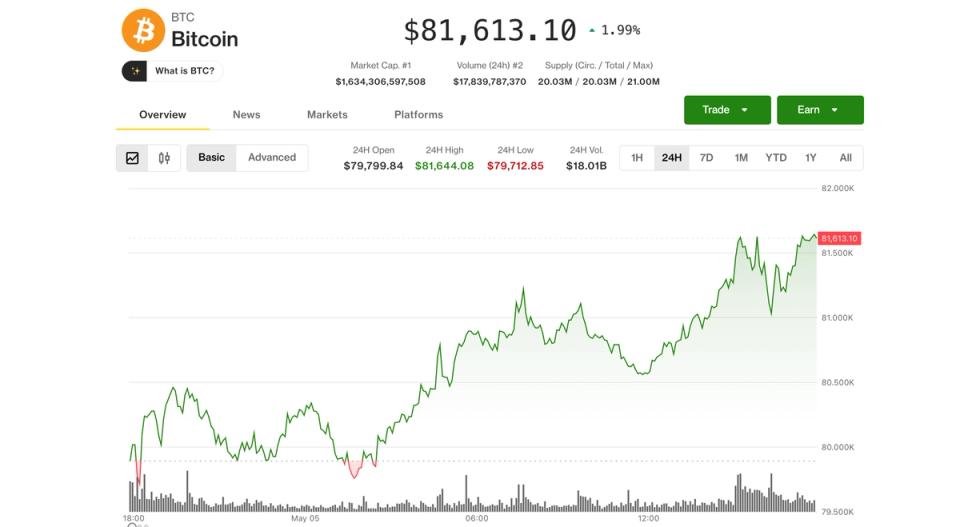
Has the entire crypto market just been quietly rewired, with barely anyone noticing? That’s the question that started bubbling up this week, as Bitcoin, that perpetually attention-grabbing titan, extended its impressive rally to hit $81,500. While the narrative bandied about by analysts and the usual talking heads points to the ongoing love affair with spot Bitcoin ETFs — and sure, the $500 million-plus daily inflows are nothing to sneeze at — a deeper, more complex story is unfolding beneath the surface. This isn’t just about more money chasing the same old asset; it’s about a subtle but significant architectural shift driven by the quiet, relentless march of tokenization.
Look, the daily ETF flows are important, undeniably. They’re the visible surge, the tide lifting all boats. Paul Howard of Wincent correctly points out the continued investor appetite, a comforting signal in a market that often feels like a pinball machine. But to attribute Bitcoin’s sustained climb, and the outsized gains in specific altcoins and crypto-adjacent equities, solely to these inflows is like saying a skyscraper is built just because the cement trucks are arriving. What’s truly fascinating is where the real momentum is concentrating: in the so-called tokenization plays.
Beyond the ETF Hype: Where the Real Action Is
This isn’t just a theoretical construct; it’s playing out in real-time market action. Bullish, the company that also happens to own CoinDesk (a delightful bit of meta-commentary here), saw its stock surge 12%. Why? A $4.2 billion acquisition of Equiniti, a move that loudly signals a pivot from just being a crypto exchange to becoming a capital markets infrastructure provider. Owen Lau, an analyst at Clear Street, nailed it: “Strategically we see this acquisition as a big push to transform Bullish from a crypto exchange to a capital market infrastructure provider capturing the tokenization trend.” It’s about building the plumbing, not just selling the water.
Then there’s Galaxy Digital, already a major player, which is now partnering with State Street to launch a tokenized cash-management fund for institutional behemoths. Their stock ticked up 3.6%. Meanwhile, on the token side, Centrifuge’s native token, CFG, jumped a whopping 15%. This isn’t happening in a vacuum. Coinbase, the crypto behemoth itself, is tapping Centrifuge to help bring ETFs, credit, and structured products onto blockchain rails. This is the kind of institutional endorsement that makes the hairs on the back of your neck stand up, signifying that the infrastructure for tokenizing traditional finance is no longer a niche experiment but a burgeoning sector.
The market projections are staggering. Ripple and BCG estimate the tokenized asset market, even excluding stablecoins, could hit $18.9 trillion by 2033. That’s not just big; it’s transformative. It suggests a fundamental recalibration of how financial assets are created, traded, and managed. We’re moving from siloed, slow-moving, batch-processed systems to something far more fluid, continuous, and real-time. The convergence isn’t just about bringing finance onto the blockchain; it’s about the blockchain fundamentally changing the architecture of finance.
“Legacy financial systems face pressure as tokenization and real-time trading push markets toward always-on, automated infrastructure.”
This quote, from panelists at Consensus, encapsulates the core tension. Traditional systems, built for a world of T+2 settlement and human intervention, are showing their age. They’re creaking under the pressure of market participants who increasingly expect 24/7, machine-driven trading and instant settlement. Tokenization, with its promise of atomic swaps and continuous liquidity, offers a compelling alternative. It’s the digital equivalent of upgrading from a dial-up modem to fiber optic – a complete change in speed, capability, and user experience.
The Architecture of Tomorrow’s Markets
What we’re witnessing is a subtle but profound architectural shift. The tokenization push isn’t merely a new product category; it’s a foundational technology that can underpin a completely new generation of financial markets. It’s about digitizing ownership, enabling fractionalization of illiquid assets, and creating a layer of programmable trust that traditional systems struggle to replicate. This is why companies like Bullish and Centrifuge are attracting attention – they are building pieces of this future architecture.
Of course, it’s not all rosy. Some crypto stocks, like Circle and Coinbase, even saw minor dips, hinting at internal rotations and the ever-present market volatility. But the overarching narrative suggests a deepening of the crypto economy’s integration with traditional finance, not through simple investment, but through technological adoption and infrastructure building. The ETF inflows are the symptom; tokenization is the underlying cure (or perhaps, the new disease, depending on your perspective).
The question isn’t if legacy systems will be pressured, but how quickly and how completely tokenization will rewrite the rulebook. The current market rally, beyond the headlines about Bitcoin’s price, is a powerful signal that the industry is finally waking up to the profound implications of bringing real-world assets onto the blockchain. It’s a shift that’s less about speculation and more about a fundamental evolution in how value is created, transferred, and managed.
🧬 Related Insights
- Read more: Saylor Buys Bitcoin Again? Strategy Signals More BTC Acquisition
- Read more: Kraken’s Payward Acquires Bitnomial: US Crypto Derivatives in Focus [Analysis]
Frequently Asked Questions
What does tokenization mean for traditional finance? Tokenization promises to make traditional financial assets more liquid, accessible, and efficient by representing them as digital tokens on a blockchain. This can enable fractional ownership, 24/7 trading, and faster settlement times, potentially reducing costs and increasing investor participation.
Will tokenization replace existing financial markets? It’s more likely to augment and transform them rather than outright replace them. Tokenization can integrate with existing infrastructure, creating hybrid models that use the strengths of both traditional finance and blockchain technology. The pace and extent of this integration will depend on regulatory clarity and market adoption.
Is Bitcoin’s rise solely due to tokenization? While tokenization is a significant bullish driver and a key theme attracting institutional interest, Bitcoin’s rise is multifaceted. Spot Bitcoin ETF inflows remain a substantial catalyst, providing mainstream access and demand. However, the growing focus on tokenization suggests a maturing crypto market where underlying technological advancements are increasingly influencing asset prices.