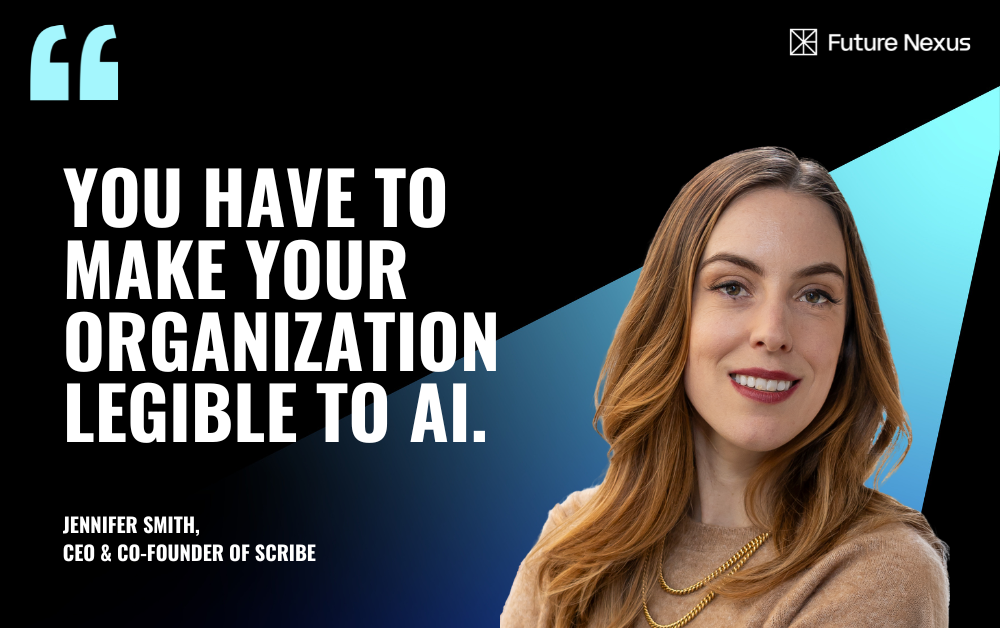
This isn’t just about another tool hitting the market. This is about your entire workday morphing, becoming something new, something… amplified. We’re talking about AI as a genuine colleague, not just a fancy calculator. But here’s the kicker: For that AI teammate to show up, ready to collaborate, your company needs to speak its language. And that language, according to Scribe CEO Jennifer Smith, is ‘legibility.’
It sounds a bit sci-fi, right? Making your organization legible to AI. But think about it like this: Imagine trying to teach a brilliant but utterly alien apprentice the intricacies of your craft. You can’t just point and say, ‘Do that.’ You need to break it down, show them the steps, explain the ‘why.’ That’s essentially what ‘making your organization legible’ means. It’s about translating the messy, human reality of how work actually gets done into a format an AI can understand and act upon.
The problem Scribe tackles is ancient, but the stakes have never been higher. For years, companies have struggled with the ‘missing middle’ – the opaque workflows, the unquantifiable decisions, the sheer human know-how that lives in people’s heads. They see inputs (people, money, tools) and outputs (revenue, tickets closed), but the magic in between? Utterly invisible. It’s like running a restaurant where you know how many customers you have and how much money you made, but you have no idea how the kitchen actually cooks the food. This isn’t just an efficiency problem; it’s a critical risk, especially now.
“They told me, ‘People are my most valuable asset.’ ‘They show up to work every day. They’re doing really valuable things, but I don’t always know what those things are.’”
This is where the ‘Barbara problem’ comes in. You know Barbara, right? Been there forever, does this one super-important thing nobody else quite grasps, and she’s retiring next year. Poof. Decades of institutional knowledge, gone. Before AI, that was a headache. Now? It’s a chasm. Powerful AI agents are about to flood the scene, capable of incredible feats. But if they don’t know how your specific business operates, what tasks are critical, or the nuanced steps involved, they’re just shouting into the void. They need context. They need to be able to read your organization.
Scribe’s answer is elegantly simple: Capture. It’s a tool that watches the experts – the Barbaras of the world – as they perform a task and automatically generates step-by-step guides. No manual documentation, no tedious note-taking. It’s about extracting that invaluable ‘how’ directly from the source. Suddenly, a new hire can learn complex processes as easily as an old hand. It democratizes expertise, essentially leveling up everyone to the expert’s proficiency from day one.
And it gets even more fascinating with Scribe Optimize. If Capture answers ‘What are we doing and how?’, Optimize asks the tougher question: ‘Where can we be better?’ This isn’t just about finding the fastest route; it’s about proactive, agentic analysis of your actual workflows. It spots bottlenecks, identifies automation opportunities, and pinpoints areas where your team might be fumbling through processes that could be streamlined. This is where AI moves from a passive scribe to an active consultant, but it can only do that if it has the data – the legible workflows – to analyze.
Is This Just More Corporate Hype?
Let’s be honest, the language around AI can get loud. ‘Revolutionary,’ ‘game-changing,’ all that jazz. But Scribe’s approach feels grounded in a fundamental truth about AI adoption: utility. AI won’t replace people; it will augment them. Smith’s vision for salespeople is a prime example. They don’t go into sales because they love data entry; they do it because they love connecting with people and solving problems. AI, made legible, can handle the grunt work – the CRM logging, the follow-up emails – freeing up that human energy for what humans do best. It’s about giving people use, not just replacing tasks. This isn’t about making your job obsolete; it’s about making your job better.
Why Does Legibility Matter for the Future of Work?
The core idea here is that AI, at its best, will act as a super-powered assistant that deeply understands your operational context. Think of it like giving your AI colleague a detailed, real-time operational manual for your entire business. This manual isn’t static; it’s constantly updated by Scribe’s capture and analysis tools. Without this, AI remains a generalist, a bit like a brilliant student who aces every subject in theory but can’t apply it to a specific, messy real-world problem. For AI to truly move from a tool to a collaborative partner, that deep understanding of how work flows through your organization is non-negotiable. It’s the bedrock upon which true AI-human synergy will be built.
This shift demands a fundamental rethink of how organizations document and share knowledge. It’s no longer about dusty binders or intranet pages that nobody updates. It’s about creating a dynamic, living understanding of your operations that AI can consume and act upon. This is the next frontier in operational efficiency, turning the intangible ‘know-how’ into a tangible, AI-readable asset.
We’re at a fascinating inflection point. The tools are rapidly advancing, but the organizations that will thrive are the ones that learn to communicate effectively with these new digital teammates. Making your organization ‘legible’ isn’t just a clever phrase; it’s the essential prerequisite for unlocking the true collaborative power of AI. Get ready for your workflows to be read, analyzed, and ultimately, supercharged.