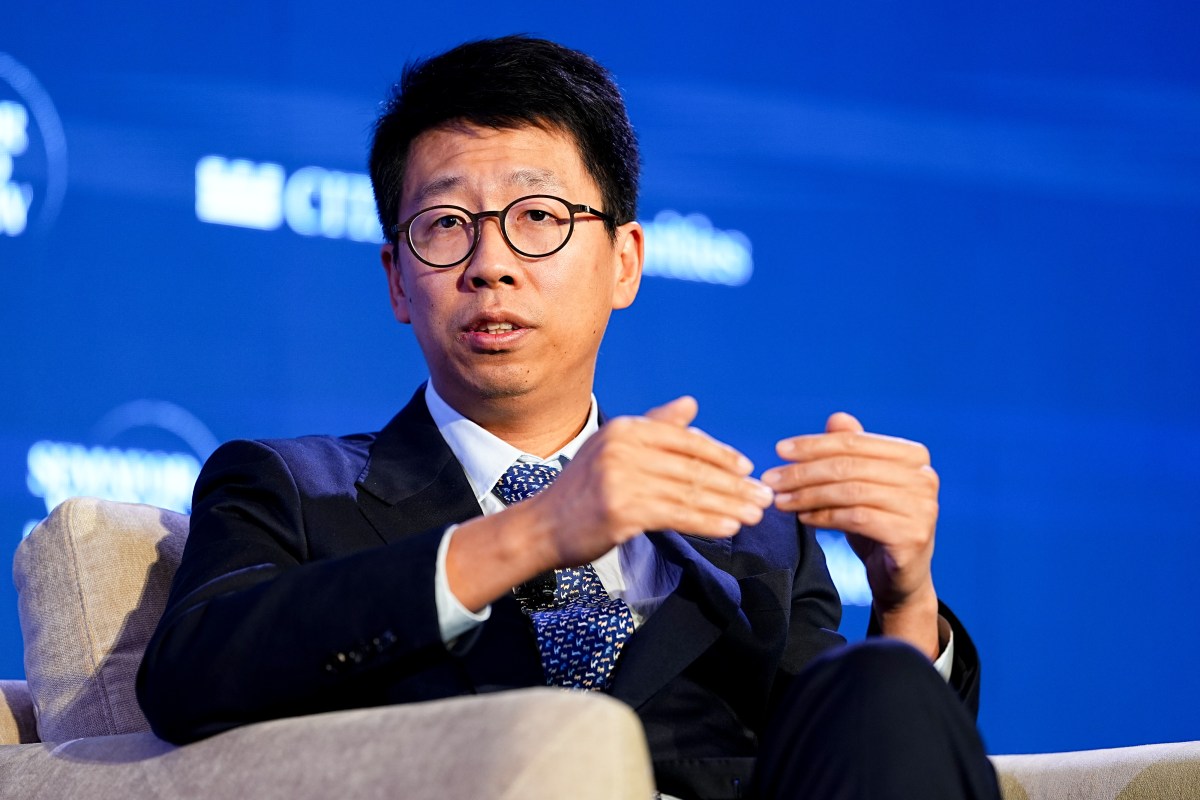
Jack Zhang was 34 years old, three and a half years into running a startup, and sitting across from one of the most powerful investors in Silicon Valley. Michael Moritz of Sequoia had invited him to his home — a place with, Zhang recalls, a couple of floors and a view straight to the Golden Gate Bridge — to make the case for selling.
Stripe wanted to buy Airwallex for $1.2 billion. At the time, the Melbourne company had around $2 million in annualized revenue. The math was pretty irresistible: a revenue multiple somewhere near 600 times. Patrick Collison, Moritz argued, was a generational founder. The deal would “compound” into something extraordinary. Zhang listened. He walked around San Francisco for two weeks, restless, unable to think straight. At one point, he said yes.
Then he flew nearly 8,000 miles back home.
“I really went deep on what motivates me to build Airwallex,” he said early this week, speaking to this editor from overseas. “I was three and a half years into the business. The business was growing 100 times in 2018. And I only just sort of tasted what it [was like] to be an entrepreneur. And that’s what I’d been dreaming about.”
Two of his three co-founders had voted against the deal, which helped. But he says the clearest signal came from looking at the whiteboard back in his office. The vision was still there, unfinished: to build the financial infrastructure that lets any business operate anywhere in the world as if it were a local company.
That decision is looking increasingly prescient. Airwallex now claims more than $1.3 billion in annualized revenue and is growing at 85% year-over-year. It processes nearly $300 billion in annualized transaction volume, he says. None of it has come easily — and Zhang argues that’s precisely the point.
The Unfinished Dream
It’s a conviction that runs a lot deeper than business strategy. Zhang grew up in Qingdao, a port city in northeastern China, and moved to Melbourne at 15 without his parents, barely speaking English, living with a host family. When his family’s finances collapsed, he took on four jobs to get through a computer science degree at the University of Melbourne, according to the Australian Financial Review — bartending, washing dishes, working graveyard shifts at a gas station, picking lemons on a farm over school holidays, which he has called the hardest job he ever had. He went on to spend years writing trading code in the front office of an Australian investment bank, a job that paid well and never felt “deeply fulfilling.”
Before Airwallex, he started roughly 10 businesses: a magazine at age 14, a real estate development company, import-export operations running wine and olive oil from Australia to Asia, textiles going the other direction, a burger chain.
He was running a Melbourne coffee shop when the idea for Airwallex took shape. While trying to pay coffee bean suppliers in Brazil, Indonesia, and Guatemala, his co-founder Max Li kept watching payments disappear into correspondent banking systems — flagged and frozen by American intermediary banks enforcing OFAC sanctions rules, sometimes bouncing back weeks after they were sent. “That pushed me to really look at how correspondent banking works,” Zhang said, “how SWIFT works, and how we could build our own global money movement network.”
That’s still the idea, just scaled up considerably. Airwallex now holds close to 90 financial licenses across 50 markets. Zhang estimates Stripe has roughly half that number at best. Getting those licenses has been immensely time-consuming — in Japan alone, the process took seven years. In some emerging markets, the company had to acquire shell companies whose licenses were no longer being issued by central banks, then rebuild the technology underneath them entirely.
“You can’t really vibe-code an integration with Mexico’s central bank,” Zhang said. “We have to have a secure room — you have to do a biometric scan just to walk in to access the central bank integration.”
The point of holding these licenses isn’t regulatory window dressing. In Japan, for instance, Stripe and Square can process payments, but they’re required to immediately transfer funds out to the merchant’s bank account. Airwallex, with its fund transfer operator license, can hold those funds inside its ecosystem. That means Airwallex can, theoretically, offer richer financial services to businesses operating in that market, like offering loans or other treasury management tools, all while keeping money within its own rails.
Why Did Stripe Want Airwallex So Badly?
Look, Stripe has built an absolute empire on developer-friendly APIs and making it look easy to accept payments online. They’re the default for a lot of startups, and for good reason. They simplified a genuinely complex problem. But even the best platforms hit walls, and for Stripe, those walls were often regulatory and geographic. They built a fantastic payment gateway, sure, but they didn’t build the full financial infrastructure that allows a business to truly feel like a local entity everywhere. That’s the holy grail.
Stripe’s approach has largely been to partner or build on top of existing banking infrastructure, which is a sensible way to scale quickly. But if you want to offer more than just processing – if you want to hold balances, lend, provide local currency accounts that aren’t just passing through – you need those deep, direct relationships and licenses. That’s where Airwallex saw its opening, and where it’s now doubling down, aggressively.
It’s like the difference between having a really good mail forwarding service and owning the post office in every town. Stripe’s been the mail forwarder extraordinaire. Airwallex is trying to become the postal service itself, brick by brick, license by license. And they’re finding that some markets are much harder to crack with that latter approach. The cost and time involved in acquiring those licenses, as Zhang points out, are astronomical. But the payoff, if successful, is a moat that’s incredibly difficult for anyone else, including Stripe, to cross.
This isn’t just about payments anymore. This is about building out a full-service global financial operating system for businesses. And the fact that Stripe, once a potential acquirer, is now staring down a rapidly growing competitor that’s building out a more comprehensive, albeit slower-to-build, infrastructure is the real story here. Who’s making money? Both, for now. But the long game is about who owns the infrastructure.
Is Airwallex a Real Threat to Stripe?
When you boil it down, it’s a classic Silicon Valley tale: the predator becomes the prey, or at least, the direct competitor. Stripe, still the behemoth in online payments for many, is facing a company that’s not just chasing market share but is methodically building out the plumbing that allows businesses to operate globally with the kind of embedded financial services that can unlock new revenue streams. Airwallex’s focus on acquiring licenses and building a proprietary network, while slower, creates a stickier ecosystem. Merchants can hold funds, manage FX, and potentially access credit directly within Airwallex, reducing their reliance on multiple third-party providers.
Zhang’s background – the gritty jobs, the entrepreneurial drive – gives his vision a certain gravitas. He’s not just selling a product; he’s selling an outcome born from firsthand understanding of financial friction. And while Stripe has its massive user base and developer mindshare, Airwallex is carving out a niche by offering a more integrated, locally compliant financial wrapper. The question is whether Stripe can adapt its strategy to compete with a company that’s willing to play the long, regulated game, or if it will continue to focus on its core payment processing strengths while Airwallex builds out its financial super-app. The $1.2 billion offer now seems like a bargain for Stripe, had they managed to close it. Now, they’ll have to compete.
🧬 Related Insights
- Read more: What is DeFi?
- Read more: Coinbase Cedes x402 Payments Protocol to Linux Foundation—Tech Giants Pile In
Frequently Asked Questions
What does Airwallex do? Airwallex is a global financial infrastructure platform that provides businesses with payment processing, foreign exchange, and cross-border payment solutions. It aims to enable companies to operate internationally as if they were local.
Why did Airwallex refuse Stripe’s acquisition offer? Airwallex’s CEO, Jack Zhang, felt that building out his company’s vision of global financial infrastructure was more motivating than selling the company, especially given its rapid growth at the time.
How is Airwallex different from Stripe? While both companies offer payment solutions, Airwallex focuses on acquiring numerous financial licenses globally to build its own comprehensive financial infrastructure, allowing it to hold funds and offer a wider range of financial services within its ecosystem, whereas Stripe primarily focuses on payment processing and relies more on partnerships for broader financial offerings.